
Scrolling for the next poll feels like responsibility. On the illusion of control that too much news offers, attention in pieces, and the moment when staying informed turns into keeping watch.
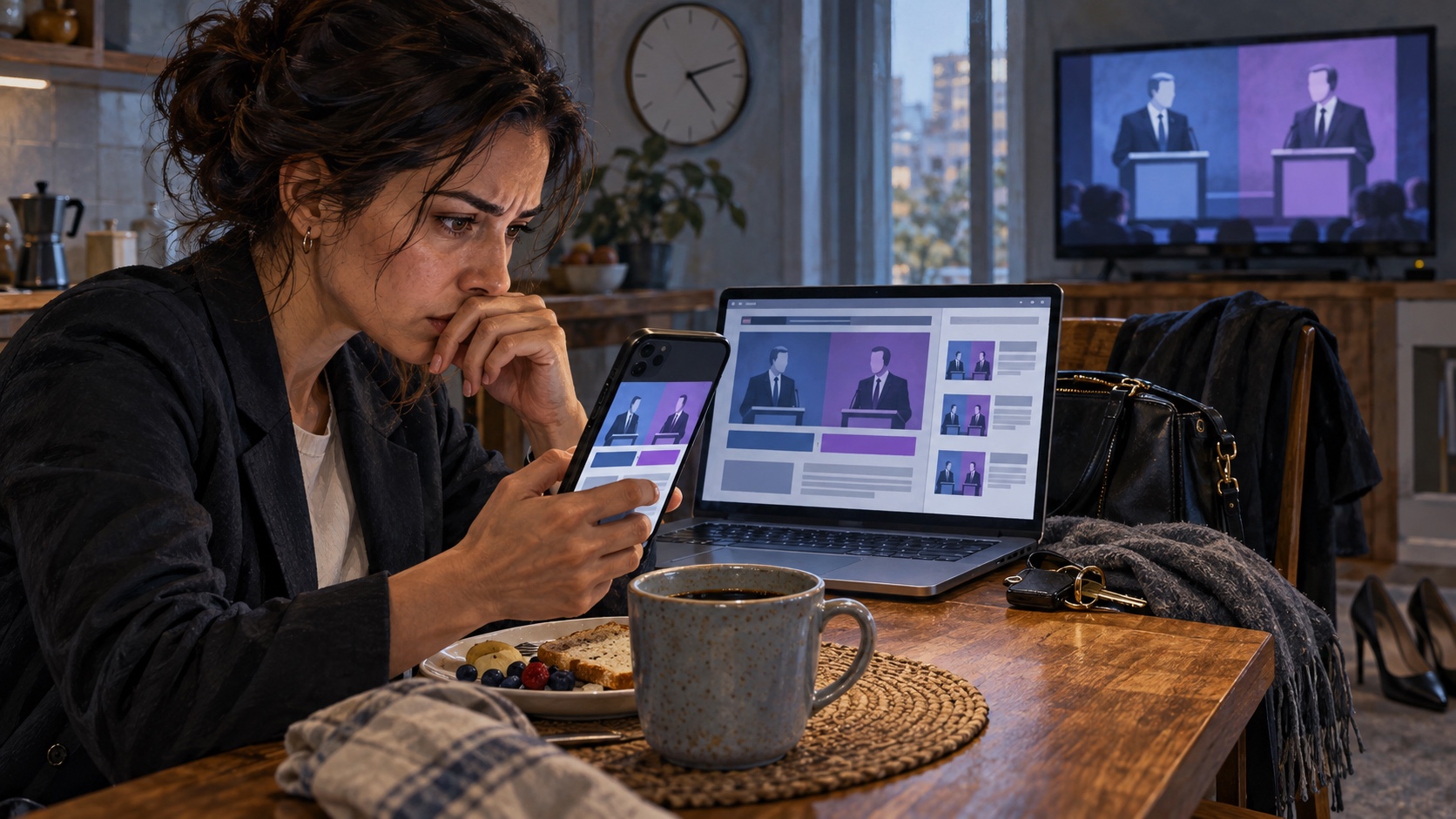
The coffee had gone cold on the table. She had ten minutes before she needed to leave the house, and her thumb kept pushing the screen upward: a new poll, a debate clip someone had cut, a stranger’s comment with two thousand likes underneath. None of it was exactly new. The poll said almost the same thing as yesterday’s. She had already seen the debate clip, from another angle, the night before. Even so, closing the app felt careless.
In the elevator, she opened it again. At the red light, too. In the ten o’clock meeting, camera off, the news page stayed open in another window. At night, on the couch, the show kept playing on TV, and no one there could have said what had happened in the last episode, because both people in the room were looking at their own phones.
If someone had asked what she’d learned that was new that day, the honest answer would have been: almost nothing. If they had asked how she was, the answer would have been different. On guard. Like someone who can’t take their eyes off a pot on the stove.
Brazil’s runoff between Flávio Bolsonaro and Lula is eleven days away, and this scene plays out the same way in homes voting for one and in homes voting for the other. The thumb has no party.
It feels careless to stop reading
People going through this rarely describe it as addiction or as curiosity. The word that comes up most is responsibility. It feels wrong not to know. It feels as if, the moment they let their attention drift for a few hours, something important will happen without them, and they’ll be the last to know: at lunch, in the group chat, over coffee at work, someone will bring up something they didn’t see.
There’s a reason this excess goes unnoticed for so long. Being well informed is a virtue, and rightly so. Nobody worries about someone who reads too much about their own country’s election; on the contrary, it looks like a sign of commitment. That’s why it’s so hard to notice the moment when reading stopped being interest and became something else. The excess comes dressed as civic duty.
And the screen plays along. Unlike a printed newspaper, it has no last page. There’s no moment when the reading ends because the content has run out. It’s always the person who has to decide when to stop, and always against the current. That’s why the act of closing the app tends to come with a pang of unease, almost of guilt, as if someone were abandoning their post. That pang is worth noticing. It says more about what’s going on than any headline.
More news, less understanding
The implicit promise is that the more you read, the more you understand, and the more you understand, the more secure you feel. In practice, the opposite tends to happen.
Information needs time to turn into understanding. You have to read, pause, connect it with what you already knew, let it settle. The continuous stream eliminates precisely that pause. The same fact arrives in fifteen versions, each one headlined more alarmingly than the last. One headline contradicts another before lunch. The video clip comes without what came before it and without what came after. At the end of the day, the person has seen a great deal and couldn’t calmly explain what actually happened.
What remains, though, is an impression of mastery. Having seen everything gives the feeling of being in the know, of holding the reins, of not being caught off guard. That is the illusion of control peculiar to information overload: mistaking volume for comprehension, and comprehension for some power over what is going to happen. Reading about an election feels like acting on it, and that feeling is part of what keeps people hooked. But following it, however intensely, doesn’t change what will come out of the ballot box.
What I often see is that the person senses this limit and, instead of stopping there, reads more. This happens to those rooting for one side and to those rooting for the other, with the same intensity and the same gestures.
A crowd that fits in your pocket
There’s a detail that weighs more than it seems: you almost never read the news alone. You read the news and, right below it, hundreds of people’s reactions to it. Anger, mockery, euphoria, fear. Before you’ve even finished understanding what happened, you already know how you’re supposed to feel about it.
Freud examined this effect in 1921, in Group Psychology and the Analysis of the Ego, when he tried to understand what changes in someone who is in the middle of a crowd. He started from a fact he considered fundamental: within the group, each person’s emotions are greatly intensified and their intellectual capacity is markedly lowered, both moving in the direction of becoming like the others around them. A person feels more inflamed, and less like themselves, than they would in a one-on-one conversation.
Freud never knew the cell phone, but the comments section works like a portable crowd. You’re lying in your own bed and, at the same time, standing in the middle of a packed square, trading shouts with everyone else. It’s no wonder you get up more irritated than when you lay down, even though nothing new has happened in your own life.
Attention in pieces and a body that won’t switch off
The most visible cost is to attention. People who spend the day going back to the screen notice it has become hard to read a book, follow a movie, or listen to someone tell a story all the way to the end. Not because they’ve lost the ability, but because their attention is now interrupted all the time, and attention that is interrupted all the time starts to anticipate the interruption. The hand reaches for the phone before the thought is finished.
The less visible cost is in the body. Every alarming headline is received, to some extent, as if it were something happening right there in the room. Breathing gets shallower, the jaw clenches, the stomach tightens when the screen lights up with a notification. Once, that’s nothing. Dozens of times a day, for weeks, and the body starts running as if it were permanently on call. It’s common for people to notice they’re tired without having made any physical effort at all.
This tiredness has a curious feature: ordinary rest doesn’t take care of it, because rest also happens with the phone in hand.
When staying informed turned into keeping watch
Seen from the outside, staying informed and keeping watch look like the same activity. From the inside, they’re very different.
Information has a beginning, a middle, and an end. It serves a purpose: knowing where to vote, understanding a proposal, talking things over with more to go on. After getting informed, a person knows something they didn’t know before and gets on with their day. Vigilance has no end. It isn’t for deciding anything; it’s meant to bring calm, and it brings none. A person reads what they already know, ends up worse off than when they started, and goes back anyway.
What changes when someone notices this difference isn’t, first of all, their screen time. It’s the question. Instead of “What just happened?” another one begins to surface, more uncomfortable and more useful: “What am I trying not to feel when I open this again?”
Sometimes the answer is fear of the result. Sometimes it’s something else, something that has little to do with politics. The news stream has a quality few things have: it fills your head completely, leaving no room for anything else. For someone going through grief, a difficult marriage, or a dissatisfaction with work that hasn’t yet found a name, this noise can work as a disguised form of relief. While the screen is talking, your own thoughts stay quiet. Without the person realizing it, the election becomes the most comfortable place to be.
I’m not going to propose a program here for putting down your phone. I’m wary of formulas like that on this terrain, because they treat the gesture and leave untouched whatever the gesture is protecting.
When it’s worth seeking help
For many people, this vigil loses its hold after the 25th, with more or less of a hangover. But there are situations that deserve a closer look.
When the same pattern has shown up before with other subjects, like a family member’s illness researched late into the night or the coverage of a tragedy that was impossible to stop following, and the election was just the subject of the moment. When sleep goes missing for several nights. When the built-up irritation starts to seep into home, work, conversations that have nothing to do with politics. When the distress starts taking over the day, and the person realizes they can no longer be fully present anywhere.
In those cases, a careful psychiatric evaluation helps distinguish the effects of a turbulent period from a condition that had already been setting in and deserves treatment of its own. And psychoanalytically oriented psychotherapy offers something no rule for phone use can: a place to think, without hurry and without anyone demanding conclusions, about what this excess has been covering up. What the full screen helps drown out. What would surface in the silence, if silence were possible.
The election will happen on the 25th whether or not the screen is open. What may deserve attention is the silence it has been filling.
Related reading
- Shorter attention span: when it isn’t just the phone
- Generalized anxiety: when worry stopped protecting and started getting in the way
- Election anxiety: when waiting for the result keeps you up at night
Can’t put down the election news?
Book your appointment here
In-person appointments in Brasília (Asa Sul) or by teleconsultation anywhere in Brazil.
Dr. Leonardo Sodré is a psychiatrist and psychotherapist in Brasília, Brazil (CRM-DF 14.206 · RQE 14.761). He holds a PhD in Psychiatry from UFRGS and teaches at the University of Brasília School of Medicine. This content is informational and educational, and does not replace individual clinical evaluation, diagnosis, or treatment.