
The phone in hand at two in the morning, the poll checked one more time. On why waiting for the runoff stirs up so much, and when the anxiety was already there before.
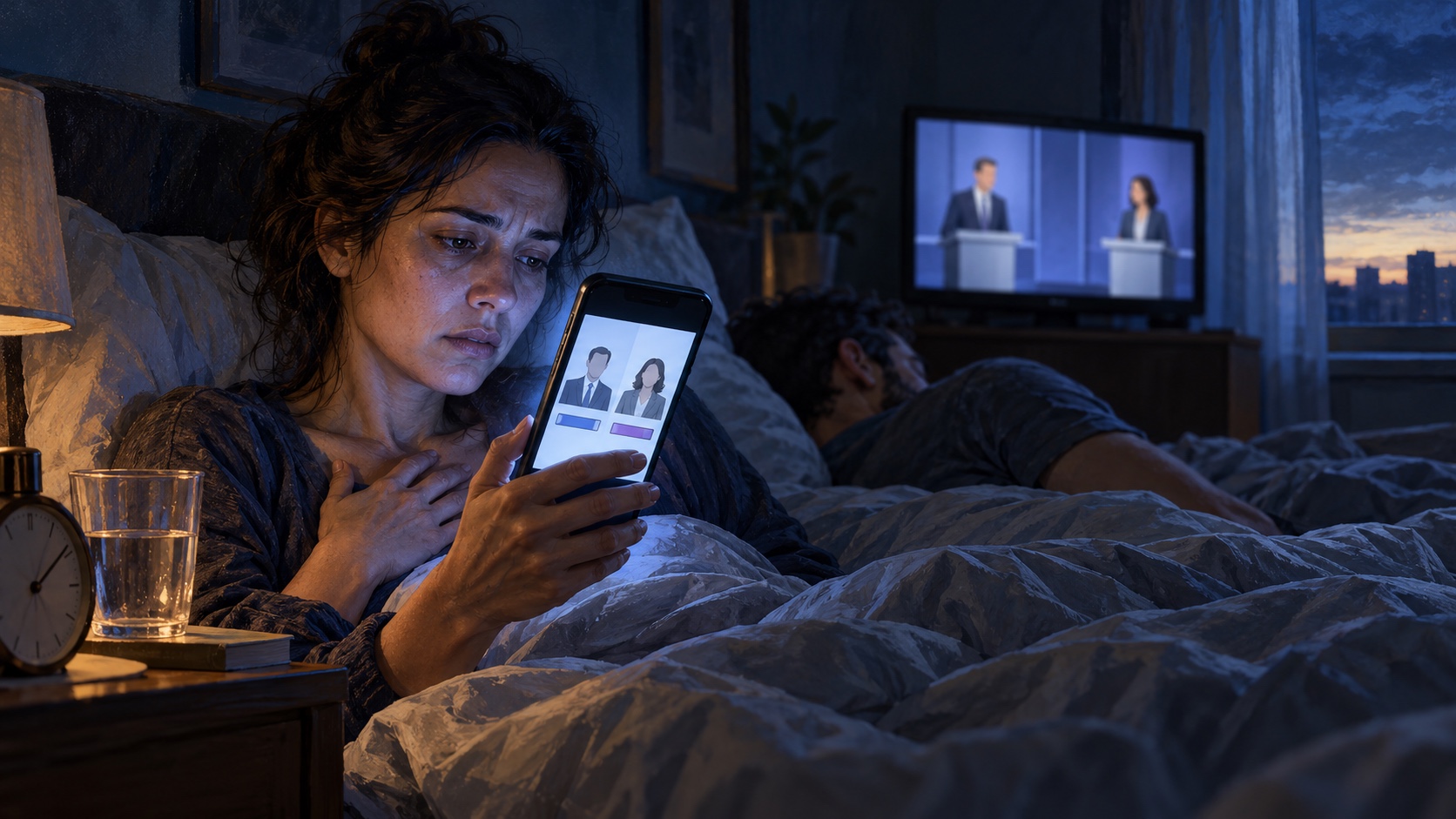
It is ten past two in the morning and the phone is in your hand again. No noise, no alert woke anyone up. Your eyes simply opened, and before there was time to decide anything your thumb was already in the news app, then on the latest poll, then in the group chat where someone posted a number at eleven last night. Nothing has changed since the last look, at eleven thirty. Even so, reading it again feels necessary.
Beside you, someone is asleep. The room is dark, the screen lights up your face, and your heart beats a little faster than it should in someone lying down. Your mind starts putting scenes together: what the Monday after the result will be like, what will be said at Sunday lunch, what changes at work, in the country, in your children’s lives. Each scene pulls in another. When sleep comes back, if it does, it is almost light outside.
In the morning there is a kind of hangover without a drink. And along with it, a small sense of shame. After all, it is an election. Grown people, with bills to pay and others to look after, losing sleep over something that does not even depend on them.
If this scene feels at all familiar, it is worth saying right away: it is far more common than it seems, and it says nothing bad about the person living it. It says something about the moment, and about the way the mind deals with what it does not yet know.
Three weeks is a long time not to know
Brazil’s first round, on October 4, ended in a close race. The runoff, between Flávio Bolsonaro and Lula, is on Sunday, October 25. Between one date and the other lie three weeks in which the question that occupies so many people’s minds stays open and cannot be answered.
The mind handles open questions poorly. Oddly enough, it handles them worse than many bad answers. Difficult news, when it arrives, at least gives you ground to stand on: you suffer, you regroup, you start thinking about what comes next. Uncertainty offers no ground at all. It keeps the body on alert without an object, like someone standing on a platform waiting for a train that has no schedule.
And it is not a quiet uncertainty. There are polls almost every day, each with a small shift that looks enormous, commentary, video clips, predictions that contradict themselves within an afternoon. Every new piece of information reopens the question instead of closing it. That is why the wait wears people out in a way the result itself, whatever it is, probably will not.
This strain is not peculiar to Brazil. In its 2024 Stress in America survey, the American Psychological Association found 69% of American adults saying the presidential election was a significant source of stress. In 2016, the figure was 52%. Contested elections weigh, everywhere, on those who follow them closely.
Anxiety lives in what has not happened yet
What goes on at two in the morning has a name: anticipatory anxiety. It means suffering now, in full, something that may happen later. The mind rehearses the future, and the body reacts to the rehearsal as if it were opening night. The heart speeds up at an imagined scene, the shoulders tighten over a conversation that has not taken place, the stomach knots over a result no one knows.
Anticipation rarely rehearses just one version. It goes back and forth. If it goes one way, it imagines one thing; if it goes the other way, it imagines another. And both end up being lived a little, so that over three weeks a person goes through both outcomes, even though only one of them will actually happen.
There is something protective in this, and that is why it is so insistent. Anticipating gives the impression of being prepared: if I have already thought of the worst, it will not catch me off guard. The trouble is that the preparation never ends, because there is always one more scenario to consider. Anxiety promises that, by thinking enough, you will be ready. That moment of being ready never arrives.
Checking the news the way you check the locked door
Almost everyone has gotten out of bed to see whether the door was locked, knowing that it was. The relief does not last, and sometimes you get up again. These weeks, the phone plays the part of the door.
Checking the poll, the news site, the group chat gives a brief sense of control. For a few seconds, being informed feels like being protected. But the new information does not change what is at stake, the feeling fades quickly, and that calls for another check. The cycle feeds itself, and the day ends with more exhaustion, not more calm.
Underneath it lies a truth that is hard to swallow: the result does not depend on the person reading. Each person has one vote among millions, and Sunday will arrive with whatever outcome it brings. Recognizing this is not indifference. It is admitting the limit of what is within reach, and that admission often hurts more than the anxiety itself, which at least gives the impression that something is being done.
What seems to be at stake on Sunday
It would be easy to say it is only politics, but for many people it is not. A presidential election stirs layers that lie well beneath the vote: the sense of belonging to the country you live in, the idea you have of your children’s future, the fear of waking up in a place you no longer recognize. And also something smaller and closer to home, which is the prospect of ending up on the losing side in front of the people you live with every day.
This fear runs through everyone, on one side and the other. For some, the unrecognizable country has one shape; for others, the opposite shape. The content changes; the outline of the fear is the same. Whoever is losing sleep dreading one result has, somewhere, a neighbor or a cousin losing sleep because they dread the other. Remembering this solves nothing, but it restores some sense of proportion when your own anxiety seems like the only reasonable one.
The English pediatrician and psychoanalyst Donald Winnicott, in the papers collected in The Maturational Processes and the Facilitating Environment (1965), gave the name holding to an experience that comes long before any election: being inside an environment that holds you, that goes on existing from one day to the next without needing to be watched. The idea was born to describe the baby and the person caring for it, but it sheds light on the adult as well. We, too, need environments that hold up without our vigilance. Much of what people feel these weeks is the threat, real or imagined, that this environment will change shape. And when the ground feels uncertain, the mind tries to hold it up on its own. At two in the morning, phone in hand.
When it is no longer only the election
Part of the anxiety of these weeks is proportionate to the moment and tends to ease after the 25th, whatever the result. The election ends, the subject loses its urgency, sleep returns to its rhythm. But there are signs that what is happening is bigger than the election, and they deserve attention.
The first is sleep that disappears for several nights, not just sleep that gets lighter. The second is worry that spreads: it starts with politics and, before you know it, it is about work, health, the children, with no letup. The third is the body: tightness in the chest, shortness of breath, episodes of intense fear that come on suddenly and seem unrelated to what you were thinking about. And there is a fourth, perhaps the most important, which is realizing that this state did not begin now. That the election simply gave a subject to a restlessness that was already there, sometimes for years, and that used to latch onto other things.
An election is a good developer, in the photographic sense. It does not usually create an anxiety disorder out of nothing, but it can make visible one that had been managed in silence. When the distress starts to take over the day, or when thoughts appear that frighten you, it no longer makes sense to wait for Sunday to pass. It is worth being evaluated by someone who looks at the whole picture, not just the part the election lit up.
What the anxiety is carrying
There are situations in which relieving the symptom is the first need, and only a careful psychiatric evaluation can say how to do that for each person. But treating anxiety only as noise to be switched off leaves out an important part of it.
Anxiety also speaks. It tends to carry things that do not fit inside politics and that politics, for a while, helped hide: the fear of losing one’s place, the difficulty of tolerating not knowing, an old feeling that the world only stays standing if someone keeps watch. In my practice, what I tend to see is that the question “how do I make this stop?” soon opens the way to others. Where does the demand to control what cannot be controlled come from? Why did it show up with such force right now? What would be exposed if the vigil stopped?
Psychoanalytically oriented psychotherapy is a place to think through these questions with time, without rushing to conclusions, in front of someone who is not rooting for any outcome. Not to convince the anxiety that it is exaggerating, but to understand what it has been trying to protect.
Sunday will come, and with it a result. The anxiety may leave along with it, or it may stay and look for another subject. It is worth paying attention to which of the two happens.
Related reading
- Generalized anxiety: when worry stopped protecting and started getting in the way
- When keeping everything in order becomes suffering: perfectionism, anxiety, and the exhaustion of never quite getting there
- Shorter attention span: when it isn’t just the phone
Has waiting for the runoff been keeping you up at night?
Book your appointment here
In-person appointments in Brasília (Asa Sul) or by teleconsultation anywhere in Brazil.
Dr. Leonardo Sodré is a psychiatrist and psychotherapist in Brasília, Brazil (CRM-DF 14.206 · RQE 14.761). He holds a PhD in Psychiatry from UFRGS and teaches at the University of Brasília School of Medicine. This content is informational and educational, and does not replace individual clinical evaluation, diagnosis, or treatment.