
Many people cut back their own treatment for fear of becoming dependent. What gets confused in that calculation — and the cost of undertreating.
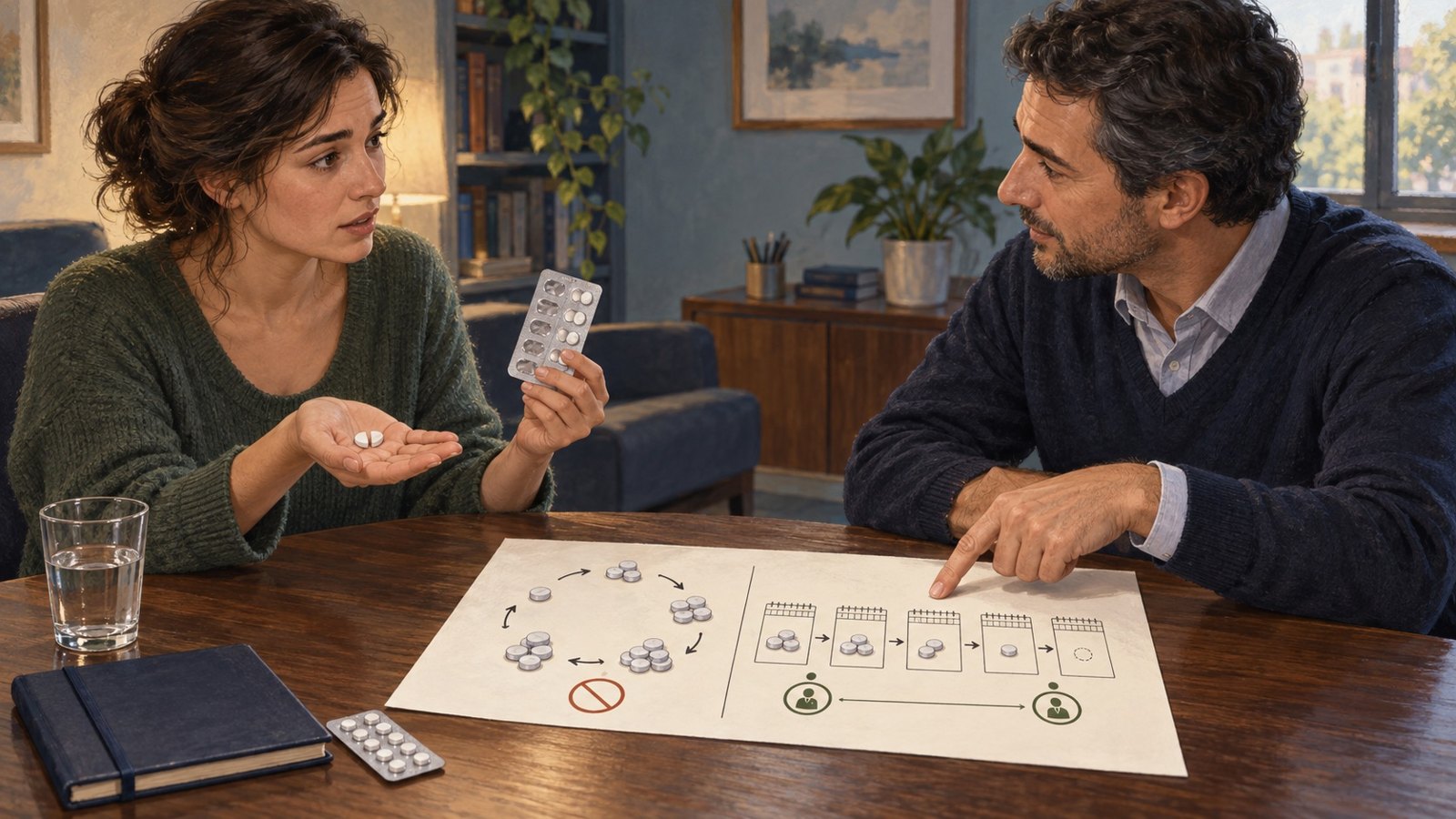
She doesn’t bring it up during the appointment. She brings it up afterward, when the conversation has loosened, and almost always in the tone of someone confessing something.
That for a while now she’s been splitting the tablet. Not every day — only on the days she feels better. Or that she stopped one of the two, because two felt like too much. Or that she’s been stretching the pack: skips a day here, another there, so a thirty-day prescription lasts forty-five.
Nobody does this out of carelessness. People who do it are trying to protect themselves from something very specific, and it usually comes out in these words: I’m afraid I won’t be able to stop.
The fear isn’t foolish
Worth starting there, because anyone carrying this fear has already had plenty of people treat it as ignorance.
It isn’t. You look at the pack and see an object you take every day, that produces an effect in your body, and that — you suspect — your body may come to require. That’s a sensible intuition about how substances work. It’s just being applied to the wrong place.
And there’s a second layer that almost never makes it into the conversation. Anyone who lives with phobias knows the mechanism well: there’s a feared thing, and there’s the immediate relief that comes from avoiding it. The relief is real, and it’s exactly what teaches you to avoid again next time. Medication can enter that loop as one more feared object — and then cutting the dose gives the same momentary relief as not getting into the elevator. Recognizing this isn’t weakness. It’s noticing that the fear has found a new address.
Two different things that became one
The knot in this fear is a confusion between two phenomena that are unrelated, and that everyday language has merged.
Dependence, in the sense of addiction, has a recognizable signature. You come to need more to get the same effect. You pursue the substance in a way that runs over other parts of life. You feel craving when it’s missing. You keep using even as the harm piles up. It’s a pattern of behavior, not just a bodily reaction.
Discontinuation symptoms are something else entirely. They’re the discomfort that appears when a system that adjusted to the presence of a substance has to readjust to its absence — especially if the withdrawal is abrupt. There’s no craving, no pursuit, no escalation. It’s a period of readaptation, predictable, crossed in a planned way and with supervision.
The practical difference is this: nobody raises their own antidepressant dose chasing an effect. That account doesn’t exist. What does exist, constantly, is the opposite — people lowering it on their own.
Counting tablets isn’t measuring risk
Here’s the part that’s hardest to accept, and I understand why.
Intuition says less medication is always safer. One tablet beats two. Half beats one. It’s a simple sum, and a simple sum is comforting when you’re afraid.
But it measures the wrong thing. It measures quantity of tablet, when what matters is whether the condition is controlled or not.
Insufficient treatment doesn’t produce a visible signal. Nobody feels “the side effect of too low a dose.” What shows up is something else, and it takes a long time to be read as a consequence: the months that don’t improve, the year that passes unchanged, the sense that this has no solution. The cost of undertreatment doesn’t arrive as a symptom. It arrives as lost time.
And there’s a detail that inverts the whole calculation: the longer a condition stays active, the harder it tends to be to treat later. Controlling it well and early tends to require less total time on treatment. Controlling it halfway, for longer, usually requires more.
A higher dose or a combination isn’t a verdict on you
When someone hears they’ll need a larger dose, or more than one medication, the near-automatic reading is: so my case is severe. Or worse: so they’ve tried everything and nothing worked.
Neither is necessarily true.
Dose isn’t a measure of how ill a person is. It’s a measure of what that organism needs for the effect to happen — and that varies enormously between people, for reasons that have nothing to do with willpower or with the moral gravity of the condition.
And combining medications, when it’s indicated, is often the route to using less of each, not more. Two pieces working at different points can reach the control that one piece alone would only reach by being pushed to its limit. The tablet count goes up; the load on the body, often, does not.
I’m not going to write here which dose, which medication or which combination — that’s a clinical decision, made case by case, in the consulting room, not in a blog post. What can be said is what those choices mean, because that’s where the misunderstanding lives.
The fear produces exactly what it fears
This is the part that usually reorganizes the conversation.
Someone who reduces their own treatment for fear of being stuck on medication frequently ends up treated by half. Treated by half, they don’t properly improve. Not properly improving, the moment when withdrawal could be planned safely never arrives. And so they keep taking medication — for longer, and with less result.
The shortest path to stopping one day is the opposite of what the fear suggests: treat properly now, reach real control, sustain it for as long as needed, and then plan the exit with your doctor, slowly, together.
Stopping is part of the treatment. It’s just the last part, not the first.
What to do with this fear
Not swallow it, and not talk yourself out of it by force.
Take it into the appointment instead of settling it alone in the kitchen, sorting tablets. Ask directly: is this addictive? what happens if one day I want to stop? how long will I need this? what will the exit look like?
These are legitimate questions, and a treatment that can’t withstand being questioned isn’t a good treatment. What doesn’t work is the silent adjustment — because then your doctor goes on evaluating a plan that, in practice, isn’t being followed, and the two of you are looking at different things.
If you recognized yourself here, the good news is that none of this has to be decided alone, and none of it has to be decided today.
Related reading
- Depression: “I have tried everything and nothing works” — is that really so?
- Four treatments and she is still in the dark
- The fear of taking something that gets in the way of work
Have you been adjusting your own treatment out of fear of depending on medication?
Book your appointment here
In-person appointments in Brasília (Asa Sul) or by teleconsultation anywhere in Brazil.
Dr. Leonardo Sodré is a psychiatrist and psychotherapist in Brasília, Brazil (CRM-DF 14.206 · RQE 14.761). He holds a PhD in Psychiatry from UFRGS and teaches at the University of Brasília School of Medicine. This content is informative and educational and does not replace individual assessment, diagnosis or treatment.