
Fluoxetine asks for more patience than most antidepressants, but not every delay is a matter of time. What to expect in the first weeks, and what only a reassessment can answer.
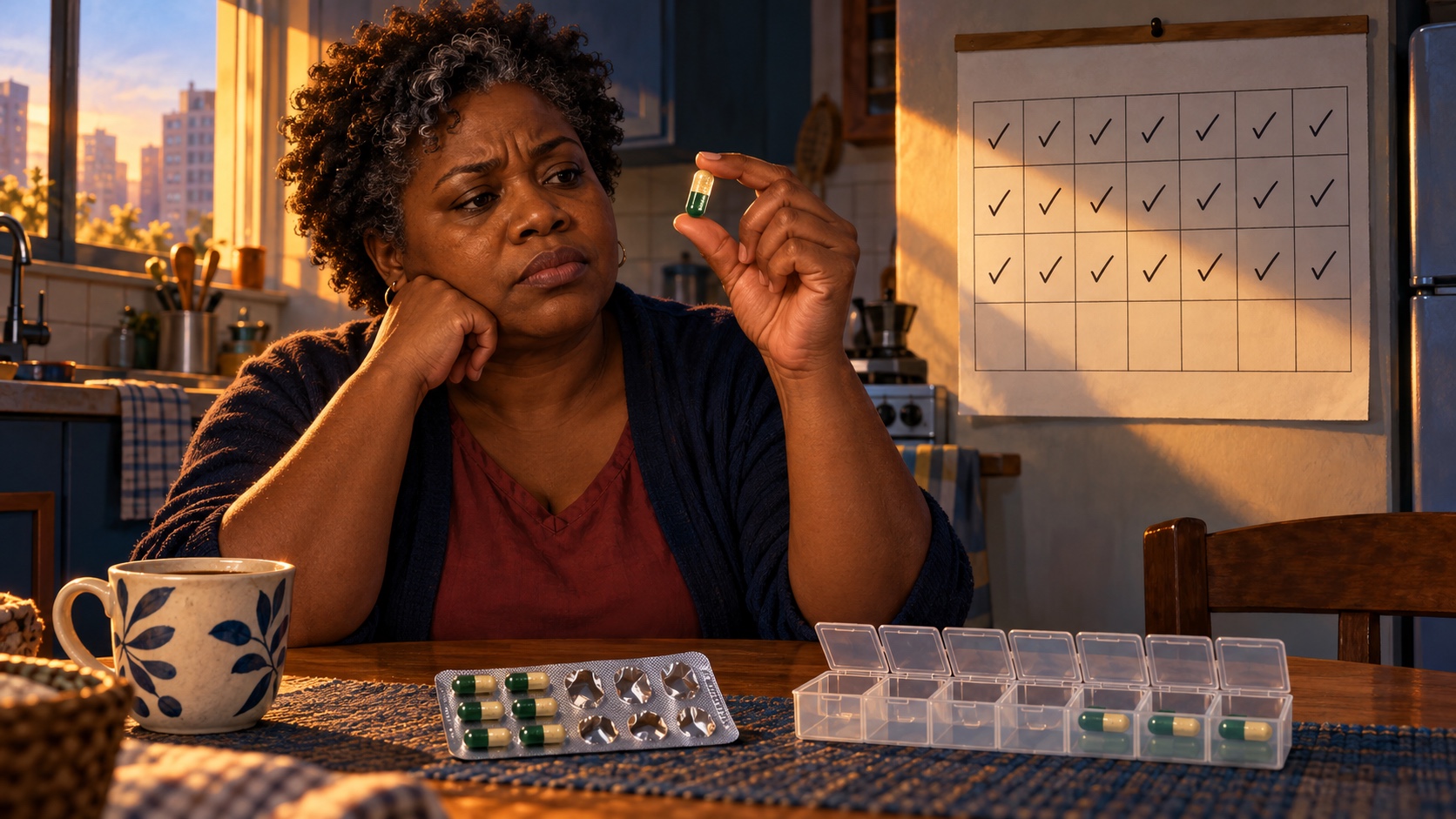
Three weeks. She takes the capsule in the morning with her coffee, and every day she runs the same silent test before leaving the house: am I better than yesterday? She can’t tell. She slept a little worse, the tightness in her chest is still there, maybe smaller, maybe the same. When her sister asks, over Sunday lunch, whether the medication is working yet, she says not yet, and regrets how curt she sounded.
At night, phone in hand, she types the question the way it comes to her. And along with the question comes an older suspicion, one that doesn’t fit in a search bar: that maybe the problem is her.
How long fluoxetine takes to work
Longer than almost everyone expects and, for a reason specific to fluoxetine, sometimes a little longer than other antidepressants. When improvement comes, the first signs usually appear between the second and fourth week, and often not in mood: they show up in energy, in drive, in the ability to handle a task that used to seem impossible.
To say with some confidence whether fluoxetine is working, it generally takes six to eight weeks at the dose the psychiatrist considered adequate. The fuller effect can take two to three months to settle in. In some other conditions it is prescribed for, such as obsessive-compulsive disorder, the timelines tend to be even longer.
So in the third week, the feeling that fluoxetine is not working is common and does not, by itself, mean the medication has failed, much less that the problem is the person taking it. But it isn’t something to keep to yourself either: it’s information your psychiatrist needs, because it helps decide the next steps.
Fluoxetine is slow to arrive and slow to leave
Every medication has its own pace of leaving the body. Doctors measure this by its half-life, which is the time the body takes to eliminate half of what it received. For most antidepressants, that count is made in hours. For fluoxetine, it’s made in days.
And there’s one more detail. In the liver, fluoxetine is transformed into another substance, also active as an antidepressant, which takes even longer to be eliminated. The result is that the level of the medication in the blood rises slowly and only stabilizes after something like four to five weeks, while several other antidepressants reach that point in about a week.
That explains part of the extra patience fluoxetine asks for. It also applies to any adjustments the psychiatrist may make along the way: the effect of a change takes longer to show than with other medications, and judging too early tends to lead to the wrong conclusions.
The slow exit has other consequences. Forgetting a single dose matters less than with medications that leave the body quickly, which doesn’t mean that taking it irregularly makes no difference. And after the last capsule, fluoxetine remains in the body for weeks. That’s why any change of course, when the psychiatrist decides on one, has to take into account what is still circulating.
What usually happens in the first weeks
Fluoxetine has a reputation for activating more than calming, and at the start this can show up as restlessness, a bit more anxiety, lighter or shorter sleep. Other common discomforts in this phase are nausea, headache, loose stools, sweating and less appetite. For many people, they ease over the first few weeks.
Improvement, for its part, often doesn’t arrive through mood first. It tends to come in at the edges: a little more energy in the afternoon, the postponed task that finally gets done, the conversation that no longer wears you out. The people around you often notice before you do, not because they’re more attentive, but because from the inside the change gets mistaken for a good day.
This creates an uncomfortable mismatch: the discomfort usually arrives before the benefit. That’s the point where many people give up, after paying the price of admission and before receiving what was coming next. Discomfort that persists or gets in the way of life isn’t meant to be endured in silence. It’s meant to be brought to whoever is following you, who can assess what is expected and what isn’t.
There are situations, however, that don’t wait for the next appointment. If the restlessness turns into agitation that’s hard to bear, if sleep disappears for several nights, if your mind speeds up in a way that’s different from usual, or if thoughts arise that frighten you, seek care immediately.
When the delay isn’t just a matter of time
After a reasonable period, the question changes. If enough weeks have gone by, with fluoxetine taken as agreed, and nothing has moved, continuing to count days stops helping. What matters now is whether something else is in the way.
The first possibility is the diagnosis itself. Some conditions present, for a long time, looking like ordinary depression. One of the most important is bipolar disorder, in which the depressive phase is usually the longest and most visible, and in which an antidepressant alone tends to help little and sometimes destabilizes mood. When this hasn’t been carefully investigated, it’s not unusual for someone to spend years trying medications that don’t reach the condition.
Other times, the center of the suffering lies elsewhere: an anxiety that organizes an entire life, a grief that never found its place, a traumatic experience that remains active. There are also conditions in which the depression is real but not alone. None of this means the treatment so far was poorly managed. It means the decisive information often wasn’t available at the start, and only surfaces when someone goes back over the history with time.
What surrounds the medication also matters
Even with the right diagnosis, there are factors that make a medication deliver less than it could. The first is how it’s taken. Skipping days, taking it only when feeling worse, stopping for a week and starting again: almost everyone does one of these things at some point, rarely out of carelessness, and each one changes what the doctor is actually evaluating.
Alcohol is another. It worsens sleep, worsens mood on the following days and takes away part of what the antidepressant can do, even when the drinking seems moderate to the person doing it. Sleep, in turn, may be the missing piece: insomnia that drags on, irregular hours, snoring that was never investigated.
Then there are medical causes, which produce or sustain depressive symptoms and are easily missed: thyroid changes, anemia, low levels of certain vitamins, chronic pain, other ongoing illnesses, medications taken for other purposes. Fluoxetine also interacts with several other medications, changing their effect and sometimes having its own effect changed, and that needs to go into the calculation too.
And there is the possibility that the treatment is incomplete by design. Medication can raise the floor of mood and give back some energy. It doesn’t, on its own, reorganize a relationship that makes you ill, a job that drains you, an old habit of treating yourself harshly. When all of that is left out, it’s common for improvement to stall halfway.
When a reassessment is worth asking for
If the weeks have passed and the feeling is the same, if improvement stalled halfway, or if the side effects are weighing more than the benefit, it’s time to look at the case again, and as a whole. A complete evaluation usually includes:
- your life history and the history of every previous treatment, with what helped and what didn’t;
- how long and at what dose the medication was actually used, and how it has been taken;
- sleep, alcohol and other substances;
- medical causes and other medications in use;
- the diagnosis, reviewed from the beginning, ideally also with someone you live with;
- the place psychotherapy holds, or stopped holding, in the treatment.
It’s from this picture that one answers what no article can: whether it’s still early, whether the dose was enough, whether the diagnosis holds, whether a piece is missing. There are specific decisions that only the psychiatrist following the case can make safely. Until then, don’t stop or change anything on your own. Even though it leaves the body slowly, fluoxetine shouldn’t be stopped without guidance, and precisely because it leaves slowly, what follows an interruption can show up weeks later, when it no longer even seems related to the medication.
Often, a reassessment also opens room for what medication can’t reach. Psychoanalytically oriented psychotherapy works with what sustains the condition from within: personal history, relationships, the way a person learned to deal with what they feel. In my practice, what I usually see is that medication and psychotherapy work better when they talk to each other, and that this conversation becomes simpler when it happens within the same treatment.
Fluoxetine asks for patience, but patience is not the same as silence. What hasn’t changed in weeks is exactly what needs to reach your next appointment.
Frequently asked questions
How long does fluoxetine take to work?
The first signs usually appear between the second and fourth week, often in energy and drive before mood. A fair assessment of the response generally takes six to eight weeks, and the fuller effect can take two to three months.
Is it normal to feel more anxious when starting fluoxetine?
An increase in restlessness or anxiety in the first weeks is relatively common and usually eases over time. Even so, it should be mentioned to your psychiatrist. Intense agitation, several nights without sleep or thoughts that frighten you call for immediate care.
Fluoxetine didn’t work: what should I do?
The first step is to bring this information to the psychiatrist following you, without stopping or changing anything on your own. Time on the medication, dose, diagnosis and everything surrounding the treatment need to be reviewed before any decision.
Related reading
- What accelerates (and what delays) the response to an antidepressant — the role of psychiatric management
- When changing the treatment is no longer the answer
- The treatment for depression that made everything worse
Weeks on fluoxetine and still no difference?
Book your appointment here
In-person appointments in Brasília (Asa Sul) or by teleconsultation anywhere in Brazil.
Dr. Leonardo Sodré is a psychiatrist and psychotherapist in Brasília, Brazil (CRM-DF 14.206 · RQE 14.761). He holds a PhD in Psychiatry from UFRGS and teaches at the University of Brasília School of Medicine. This content is informational and educational, and does not replace individual clinical evaluation, diagnosis, or treatment.