
The most widely handed-out diagnosis of election season, almost always for the other side's candidate. What psychopathy really is, and why no serious psychiatrist answers the title.
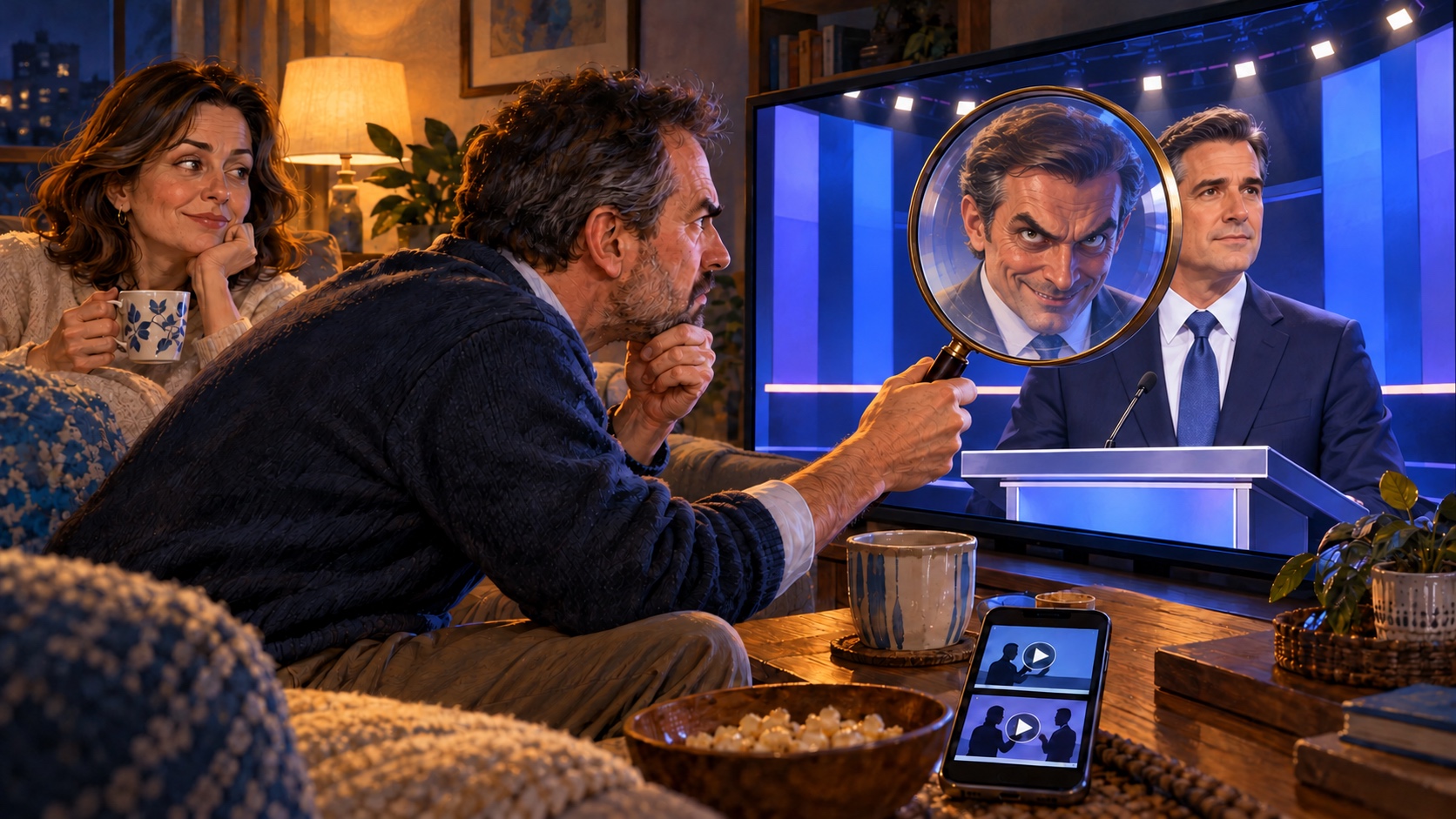
Debate night. The broadcast hasn’t even ended, and the family group chat already has a diagnosis. The uncle sends a forty-second video, cut at exactly the right spot, with suspense music in the background: a candidate smiles at the wrong moment. Underneath, the caption: “Look at the eyes. Psychopath.”
Four minutes later, the cousin replies with another video. Another candidate, another ill-timed smile, the same suspense music. The caption is almost identical. No one in the group is a psychiatrist, no one has ever been within a hundred yards of either of them, and everyone is absolutely certain.
With small variations, this scene is playing out in thousands of group chats in the final stretch of Brazil’s campaign. “Psychopath” may be the most widely handed-out diagnosis in the country in October, and the only one that requires no appointment.
If you made it this far hoping for confirmation that the other side’s candidate is a psychopath, take another look at the title. It says “my.” That was on purpose.
Psychopathy is neither an insult nor madness
To understand what psychopathy really is, it helps to start with the word. It was born in the nineteenth century, from the Greek psyche, mind, and pathos, suffering. Taken literally, a psychopath would be anyone whose mind is suffering, which, judging by family group chats in October, would include the entire electorate.
The meaning psychiatry uses today took shape in 1941, when the American psychiatrist Hervey Cleckley published The Mask of Sanity. He described people who impressed others with their charm and poise and who, seen up close and over time, revealed something else: easy lying, an absence of guilt and remorse, shallow emotions, little empathy, other people used as tools, no lesson learned from consequences. Decades later, the Canadian psychologist Robert Hare turned that description into an assessment scale that is still a reference in research today. It requires a long interview, conducted by a trained professional, and a review of the person’s life history, with records and information from the people who live with them.
Two confusions come up almost every time. The first is mistaking a psychopath for someone who is insane. Psychosis is a loss of contact with reality, with delusions or hallucinations. A person with psychopathy is usually perfectly oriented, sometimes calmer than everyone around them, and that is exactly what Cleckley’s title meant: the mask is sanity itself. The second is mistaking a psychopath for a movie killer. What research describes is usually far less cinematic: discarded promises, lies told without embarrassment, people used and left behind. The kind of damage that leaves more of a trail in bank accounts and marriages than in crime shows.
And it is rare. The most widely cited estimates in the general population hover around 1%, sometimes less. If every candidate called a psychopath during a campaign really were one, epidemiology would have a serious problem. In the diagnostic manuals, incidentally, psychopathy is not even a diagnosis of its own: its closest relative is antisocial personality disorder, which overlaps with it but is not quite the same thing.
Why the psychopath is always the other side’s candidate
In 1948, on a BBC radio program, the philosopher Bertrand Russell proposed a game that became known as emotive conjugation. It went something like this: I am firm, you are obstinate, he is a pig-headed fool. The behavior is the same; only the person doing it changes. In election season, this conjugation works like clockwork. My candidate is strategic; yours is manipulative. Mine is firm; yours is cold. Mine changed his mind because he matured; yours, because he lies.
Political science has measured this. In a study published in 2016, the American researchers Ryan Claassen and Michael Ensley presented voters with fictitious news stories about dirty campaign tricks, such as the opponent’s yard signs disappearing and phone calls giving the wrong voting hours, and randomly assigned which party appeared as the culprit. The same trick was treated more leniently when it came from one’s own side. The paper’s title sums up the finding better than any table: “Mine is a likable rogue, yours is a degenerate criminal.”
Psychoanalysis helps explain why. Melanie Klein described, in 1946, how in moments of great anxiety the mind tends to divide the world into good and bad, and to see in the other what it cannot bear in itself. In a campaign, everyone feels anger, roots for the opponent to fail, applauds a half-truth that favors their side. The word “psychopath” offers a perfect address for all of it. Coldness, calculation, indifference to the suffering of others: it is all over there, on the other side, and all I am left with is indignation.
There is also a quiet advantage to this label. If he feels nothing, I don’t need to feel anything for him. And the logic rarely stops at the candidate. Soon the next question comes: and what does that make someone who votes for a psychopath? The word that started on TV ends up at Sunday lunch, pointed at the brother-in-law.
The traits everyone has
The American psychologist Scott Lilienfeld, one of the great scholars of the subject, compared psychopathic traits to height and weight: everyone has some, to different degrees, spread continuously across the population. In 2002, researchers at a Canadian university gave a name to a trio of characteristics that appear in moderate doses in ordinary people, without any disorder: narcissism, Machiavellianism, and psychopathic traits. They called it the Dark Triad. Having a little of each is simply being human, including for the person reading this text and the person writing it.
In 2012, Lilienfeld’s team published a curious study. Drawing on personality assessments of 42 American presidents, made by biographers, journalists, and scholars of each one, the researchers examined one of the traits in the psychopathy cluster, so-called fearless dominance: boldness, little social anxiety, an ease at taking over a room. This trait was associated with better ratings of leadership, persuasiveness, and crisis management. Another trait from the same cluster, self-centered impulsivity, went in the opposite direction and was linked to poor indicators, such as tolerating unethical behavior in subordinates. The president with the highest boldness score ranked below average in impulsivity, which, according to the analysis, put him far from being a psychopath. This was not a diagnosis, but traits estimated by experts from each president’s public life.
The lesson applies to any election. Politics attracts people who are bold, persuasive, who tolerate conflict and don’t lose sleep over criticism. In excess, some of these traits are part of psychopathy. In ordinary doses, they are part of almost any leadership. Boldness is not psychopathy. Charm is not psychopathy. Changing positions is not psychopathy. What defines the condition is the whole package, persistent, over a lifetime, and above all the absence of guilt and empathy. Which are precisely the things a TV debate doesn’t show.
Why no serious psychiatrist answers the title
In 1964, an American magazine called Fact sent a questionnaire to 12,356 psychiatrists asking whether Senator Barry Goldwater, then running for president, was psychologically fit for office. A total of 2,417 responded. Of those, 1,189 said he was not, without ever having examined him. Goldwater lost the election, sued the magazine, and won. In 1973, the American Psychiatric Association turned the embarrassment into a rule: psychiatrists do not offer professional opinions about people they have not examined. It became known as the Goldwater Rule.
In Brazil, the Code of Medical Ethics points in the same direction. It forbids doctors from prescribing without directly examining the patient and from “consulting, diagnosing, or prescribing through any mass communication medium.” It applies to both runoff candidates, to all the others, and to this text as well.
But it is not only a matter of ethics. It is a matter of method. The candidate in the debate is, to a large extent, a product: rehearsed, coached by media specialists, with timed answers and hand-picked clips. What you see is the campaign, not the person. Judging someone by a debate is like judging a hamburger by the photo in the ad. And even with the person in front of you, a diagnosis like this requires hours of interviews, the history of decades, and accounts from the people who live with them. Sometimes even then the answer is not simple.
The hardest question is about your own candidate
Almost no one asks the title’s question about their own candidate, and there is a reason for that. In 1921, in Group Psychology and the Analysis of the Ego, Freud described how the leader comes to occupy, for those who follow him, the place of an ideal. When that happens, criticism, so sharp when facing the opponent, falls silent before the chosen one. Criticizing him begins to feel like criticizing oneself.
Asking the question about one’s own candidate is not looking for a diagnosis. That, as we have seen, cannot be done from the TV, for either side. It is recovering something the campaign tends to take away: the ability to see one’s own candidate whole, with strengths and flaws, and vote for him anyway, without needing to turn him into a hero. It may be the most grown-up question of an election. Not “is the other one a psychopath?” but “what would I rather not see in mine?”
It is also worth remembering a side effect of the nickname. When “psychopath” becomes an insult, it reinforces the old idea that mental disorder is synonymous with evil. People living with a real psychiatric condition, and there are many of them, pay the price.
When politics takes up too much room
For most people, calling the other side’s candidate a psychopath is an October exaggeration that passes along with the campaign. In some cases, however, politics begins to take up a disproportionate amount of space. When a person spends hours hunting through videos and clips for proof that they were right. When sleep disappears for several nights. When distrust spreads from the candidate to relatives, coworkers, neighbors, and the feeling of being surrounded by ill-intentioned people won’t go away even far from the news. When the distress starts to take over the day.
In those moments, psychoanalytically oriented psychotherapy offers a place very different from the family group chat. Not to decide who is right, nor to change anyone’s vote, but to understand what the anger at the other side’s candidate is carrying, and what the admiration for one’s own is protecting. Often, these public figures end up wearing the costumes of much older characters from our own story.
The uncle and the cousin, by the way, are not psychopaths. It’s just October.
Related reading
- When the other turns enemy: what psychoanalysis sees in political hatred
- Why politics turned into a family fight
- Election anxiety: when waiting for the result keeps you up at night
Has politics been taking up more room in your head than you would like?
Book your appointment here
In-person appointments in Brasília (Asa Sul) or by teleconsultation anywhere in Brazil.
Dr. Leonardo Sodré is a psychiatrist and psychotherapist in Brasília, Brazil (CRM-DF 14.206 · RQE 14.761). He holds a PhD in Psychiatry from UFRGS and teaches at the University of Brasília School of Medicine. This content is informational and educational, and does not replace individual clinical evaluation, diagnosis, or treatment.