
The lunch that turns into a courtroom, the uncle and the cousin who no longer look at each other. What Freud helps us understand about why politics, among those closest to us, hurts so much.
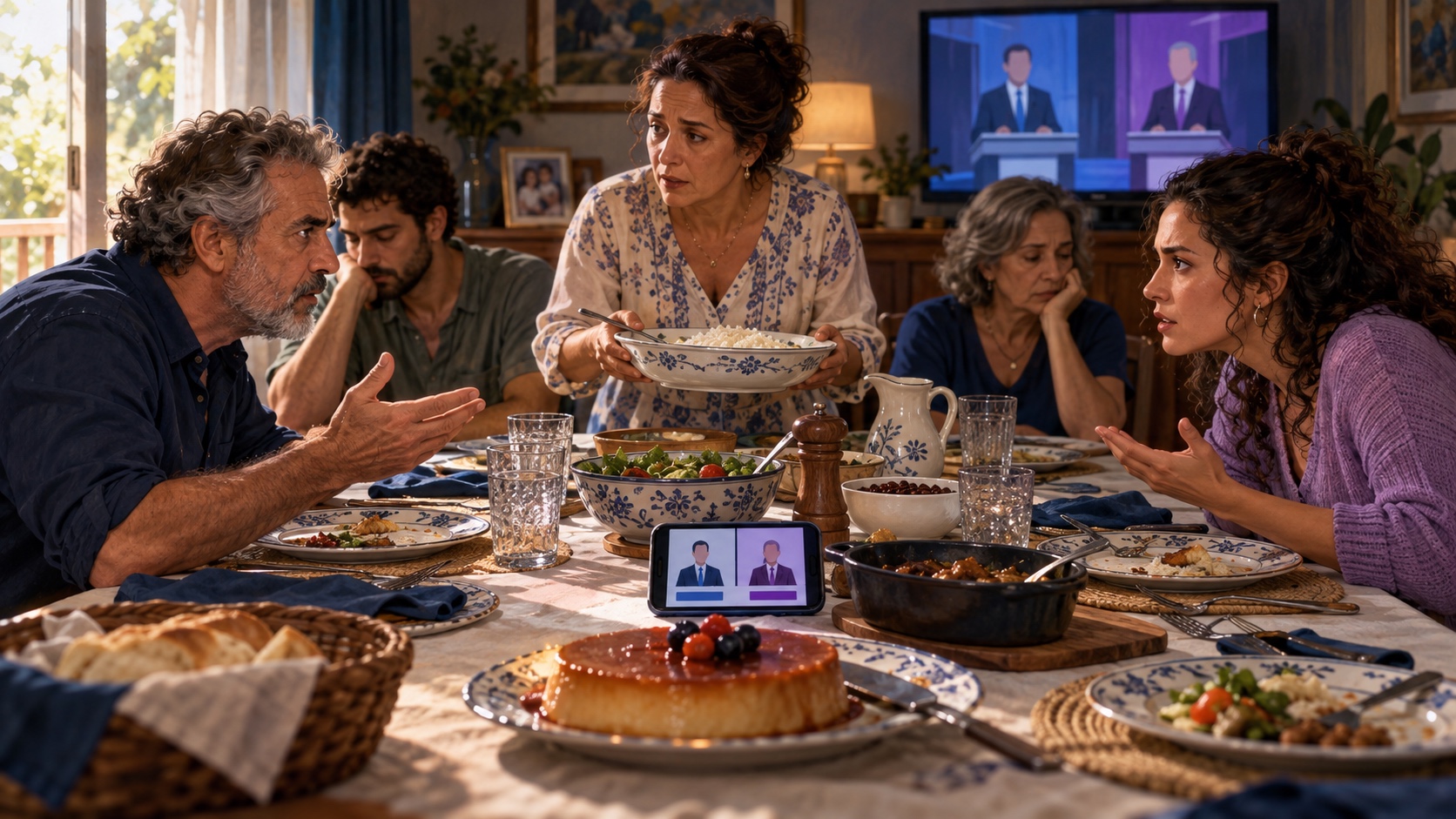
The subject came in through the side door, the way it almost always does. Someone mentioned a video that had been making the rounds in the group chat during the week, someone else laughed at the wrong moment, and in less than a minute the temperature of Sunday lunch had changed. The uncle set down his silverware. The cousin, across the table, answered before he could finish his sentence. The woman of the house tried the old standby, asked who wanted more rice, and nobody answered.
It didn’t last long. Nobody knocked over a chair, nobody stormed out slamming the door. But dessert was eaten in silence, the goodbyes were shorter than usual, and in the car on the way home the argument went on the way it goes on in so many cars: with someone who was no longer there. What should have been said. The remark that wouldn’t go down. The tone, more than the content.
And, underneath it all, a question almost nobody asks out loud. How did I end up talking that way to someone I’ve known for as long as I can remember?
Two weeks before Brazil’s runoff between Flávio Bolsonaro and Lula, this scene is playing out in many homes, with the cast swapped: father and daughter, two siblings, the couple who until recently thought they saw things the same way. Maybe you recognized your own table in this description, from one side of it or the other. What I usually hear in my practice, when politics and family fights get tangled up, is rarely about the election. It’s about why it hurt so much. And why it hurt more precisely there, among your own.
The fight is almost never about what it seems
If it were a debate about ideas, it would end differently. Someone would bring an argument, the other would bring a fact, and at some point one of them would say “you’ve got a point there.” That’s almost never what happens. Nobody changes their vote over Sunday lunch, and deep down everyone at the table knows it before the conversation even starts.
What’s at stake is something else. When the uncle defends his candidate with his voice raised, or when the cousin fires back with the kind of sarcasm she wouldn’t use on any other subject, neither of them is trying to persuade. They’re defending where they stand. And the feeling, on both sides of the table, is curiously the same: if I let this slide, something of mine will be erased.
Many people have noticed this and chosen what seemed like the safer path. In July 2022, in a Datafolha poll, 49% of voters said they had stopped talking about politics with friends and family to avoid arguments. Almost half. Silence keeps lunch intact, but it collects its price somewhere else. The subject nobody talks about doesn’t disappear from the table. It changes shape: it becomes a barbed joke, a meaningful glance, excessive care with every word, the feeling of always being one sentence away from disaster.
Why it hurts more when it comes from someone close
There’s an intuitive expectation that family should be the easiest place to disagree. There are decades of living together, accumulated affection, the certainty that nobody is going to walk away over a vote. What we tend to see is the opposite. The same opinion you can hear with relative calm from a coworker becomes an affront when it comes from your brother.
Freud called this the narcissism of minor differences, and he returned to the idea in Civilization and Its Discontents (1930). His observation was that hostility tends to run higher between those who resemble each other than between those who are entirely different. The examples he gave were neighboring peoples, related in almost everything, who were forever provoking and ridiculing one another. Freud admitted the name didn’t explain much, but he pointed to a function: this hostility helps hold the in-group together, as it recognizes itself in opposition to its neighbor.
Carried over to the lunch table, this sheds a lot of light. The family member who disagrees with us isn’t a stranger. They grew up in the same house, heard the same stories, learned the same words. That’s why their difference bothers us in a particular way: it shows that something else can come from the same origin. That what seemed obvious, and what we imagined we had received along with the family name, wasn’t so obvious after all. Disagreement from someone close threatens an idea we didn’t even know we held: that, deep down, we are the same.
Voting became belonging
There’s a second mechanism, and it helps explain why criticism of a candidate is felt as a personal insult.
In Group Psychology and the Analysis of the Ego (1921), Freud tried to understand what changes in a person when they become part of a group. His answer runs through one word: identification. Members bind themselves to a leader, or to an idea that takes the leader’s place, and put that figure in the position of what they would like to be. And because they are bound to the same figure, they begin to recognize themselves in one another. It is this double tie, to the leader and among peers, that gives the group its strength.
Freud also saw the price of this. Inside the group, individual critical judgment slackens. What a person would examine carefully on their own goes unexamined when it comes from inside, and what comes from outside is rejected before it’s even heard. He noted, about the groups he studied, that they tend to be generous to those who belong and harsh toward those left outside.
None of this belongs to one side. It’s how human groups work, and it runs through everyone: the uncle and the cousin, the person reading this and the one who wrote it. In a polarized election, the effect is predictable. Voting stops being a choice between platforms and becomes a way of saying who I am and whose side I’m on. Criticizing the candidate becomes criticizing those who identify with him. And disagreeing, at home, starts to sound like betrayal.
Two loyalties at the same table
Family is a group too, and a much older one than any election. It has its identifications, its ideals, its unspoken rules about what can and cannot be said out loud.
What makes lunch so hard during campaign season is that, right there, the two allegiances meet and start competing for the same person. If I let my father’s comment slide, I feel I’ve betrayed what I believe in. If I answer in kind, I feel I’ve betrayed my family. There’s no comfortable position, and that’s why so many people leave these gatherings feeling they lost either way, whether they spoke up or kept quiet.
There’s one more detail that tends to go unnoticed. A family has roles that were handed out long ago: the one who always smoothed things over, the one who always provoked, the one who always felt less heard. Politics rarely invents these roles. It finds them ready-made and settles into them. It’s not unusual for someone to be surprised by the intensity of their own anger and only later realize that it wasn’t all about the vote.
What is lost when the other person becomes just their vote
The quietest effect of this dynamic isn’t the fight. It’s the shrinking of the other person. Over the course of the campaign, your brother is gradually reduced to the position he defends. Everything he says passes through that filter, and every gesture seems to confirm what you already knew about “people like that.” The brother who shared a room with you for fifteen years, who showed up at the hospital when your child was born, who knows Grandma’s recipe by heart, disappears behind a vote.
And this usually happens on both sides at the same time. Each one looks at the other and sees a caricature, convinced that it’s the other who is doing it.
Recognizing the mechanism doesn’t resolve the disagreement, nor should it. Nobody has to give up what they think in order to keep sitting at the same table. But there’s a long way between disagreeing with someone and letting the disagreement erase the rest of the person. The first is part of any living family. The second is what leaves marks that outlast the election.
When the fight takes up more room than the election
For most people, this tension will ease after the 25th, even if slowly. But there are situations in which it’s about something more than the campaign, and those deserve a careful look.
When the argument keeps replaying for days, in the small hours, with rehearsed comebacks. When the anger at one particular relative seems out of proportion even to the person feeling it. When the distance has already taken over important relationships and the person no longer knows the way back. When sleep, work, or patience with the people at home start to pay the price. In those cases, the election may have been only the occasion.
This is where psychoanalytically oriented psychotherapy has something of its own to offer. Not training in how to argue better, nor a method for avoiding the subject, but a place to think about what that fight is carrying. Why that remark, said by that person, struck so deep. What the candidate represents for those who defend him, and what the other person’s vote seems to threaten. What old role was summoned to the table without anyone noticing. These questions have no quick answers, and they don’t need any. But they tend to change the way a person shows up to the following Sunday’s lunch.
The election has an end date. The family goes on after it, with everything that ends up being said at the table.
Related reading
- Election anxiety: when waiting for the result keeps you up at night
- The guilt of losing your patience with someone you love
- Generalized anxiety: when worry stopped protecting and started getting in the way
Has politics been weighing on your family’s table?
Book your appointment here
In-person appointments in Brasília (Asa Sul) or by teleconsultation anywhere in Brazil.
Dr. Leonardo Sodré is a psychiatrist and psychotherapist in Brasília, Brazil (CRM-DF 14.206 · RQE 14.761). He holds a PhD in Psychiatry from UFRGS and teaches at the University of Brasília School of Medicine. This content is informational and educational, and does not replace individual clinical evaluation, diagnosis, or treatment.