
Physicians fall ill in silence, and almost always go through it alone. A psychiatrist who treats physicians writes about the care that gets postponed.
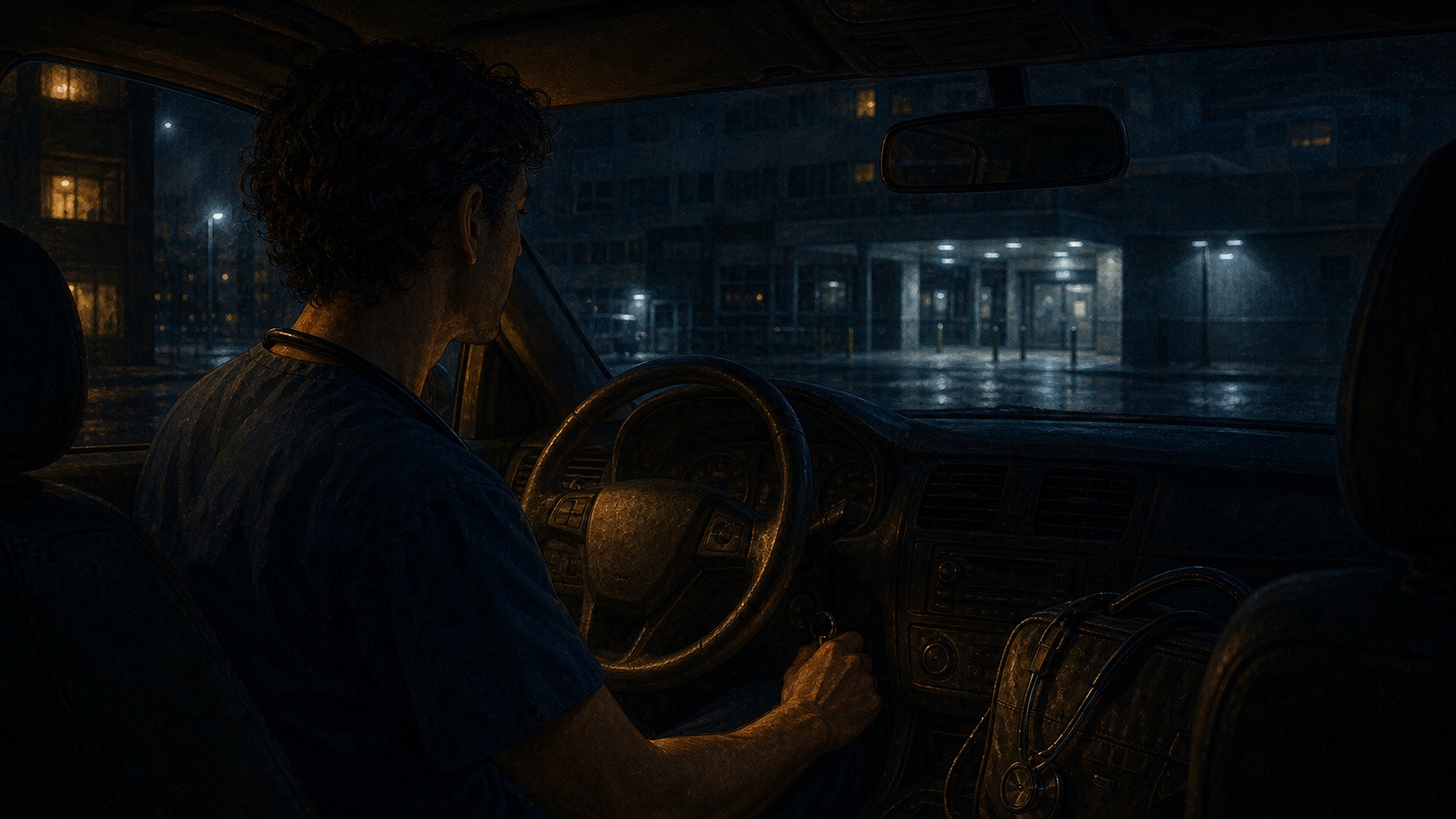
There is a time of day when it tends to show up. Not in the middle of the shift, not during the difficult consultation. Afterwards. The physician reaches the car, sits down, puts the key in the ignition — and stays there. A few minutes parked, not thinking about anything in particular, before managing to start the engine.
Nobody talks much about those minutes. They do not come up in corridor conversation, they do not appear in institutional climate surveys, they have no name. And they are, most likely, one of the most widely shared experiences in medicine today.
When a physician comes to the office and describes what has been going on, the account is usually precise. He names the administrative overload, the electronic record designed for billing rather than for clinical work, productivity measured by volume, the autonomy scraped away year after year. The analysis is impeccable. And it is correct.
Then I ask whether he has ever sought any help for himself. The answer almost always comes in the same tone, with mild surprise at the question: “Seek what? The problem is not in me.”
He is right. What is making physicians ill today is not personal fragility, nor a lack of resilience — a word that, said to someone who crossed years of training under pressure no outsider imagines, borders on offensive. It has to do with how medical work has been reorganised over recent decades, and that is not merely my impression.
Perhaps you recognized something in that description. Or perhaps you thought of a colleague — someone quieter than they used to be, who stopped coming to gatherings, who answers “I’m fine” a little too quickly.
If that is the case, either way, it is worth saying: there would be nothing wrong with it. It would be a predictable response to conditions that would make anyone ill.
What I tend to see is that understanding the cause and being cared for are different things. One does not bring the other along. And it is about that distance that I wanted to talk.
Almost everyone goes through this alone
A recent survey asked thousands of physicians about exhaustion and psychological distress. The numbers are what one might imagine: close to half report burnout at some point, almost a quarter describe some degree of depression, and an overwhelming majority point to work as the origin.
But the finding that struck me most was none of those. It was a quieter one: most physicians who are struggling go through it without telling anyone. They do not seek evaluation, they do not talk to colleagues, they do not bring the whole of it home.
Nearly six in ten said that confiding in another physician would not be an option. Among those who had never sought help, almost half answered that they would not seek it either.
If you are in that situation, this may be the most important thing this text has to say: it is not that you are being especially proud or stubborn. It is like that for almost everyone. The isolation is not a trait of your character — it is very nearly part of the picture itself.
What waiting tends to charge
There is something in these data that seems important to me and rarely comes up in conversations about this.
Older physicians report, far more frequently, an exhaustion that has already lasted more than two years. Younger ones are mostly in early phases, a few months in. Cross that with severity — more than four in ten rate their own state at the most intense levels — and what emerges is the shape of something that settles.
It does not usually pass on its own. It stays.
And there is a cost that appears in no metric, because it is paid far from the hospital. Nearly three in four physicians said it had already damaged their closest relationships. Three years earlier, fewer said so.
This is not said here to frighten anyone. It is that, in my experience, when a physician finally decides to see someone, the sentence that comes up most often is some version of “I should have come earlier”. Not out of guilt — out of recognition. He realizes the preceding years had been harder than they needed to be.
What a consultation is, and what it is not
There is a misunderstanding that gets in the way considerably, and it is worth undoing.
Seeking evaluation is not accepting that you are fragile, nor agreeing with anyone who says resilience was lacking. It is not taking a part in for repair so it can be returned to the same machinery. Nothing that happens in a consultation absolves the system of anything.
Clinically, there is one question that only an evaluation answers well: is what is happening still exhaustion tied to working conditions, or has it become something that now runs under its own power? That distinction matters, because the two do not follow the same course. And it is a question that cannot be answered alone — not for lack of knowledge, but because looking at oneself with the clarity we bring to others is precisely what we cannot do.
And there is what an analytic space offers, which is something else and deserves to be said precisely. It is not training to better tolerate the intolerable, nor a repertoire of stress management techniques. It is a place where one’s own relationship to work can be examined — what has been deposited there over the years, what was expected in return, what place it occupies in the life of someone who organized everything around it.
When an older physician says he cannot leave the residents to fend for themselves, and therefore carries on, there is something there that exceeds an analysis of working conditions. There is a position being held, at a cost, for reasons worth looking at closely — with someone, unhurried.
If something here found you
You do not have to conclude anything now. You do not have to accept any diagnosis, nor admit that you are unwell, nor decide anything at all.
The only thing I would like to leave is the separation between two questions that usually arrive stuck together: what caused this and what to do about you are different questions. You can remain entirely right about the first — and you probably are — and still deserve an answer to the second.
Being right about the cause does not take care of anyone. And you have spent a life taking care.
Related reading
- Doctor: someone who loves you may have already noticed your pain
- The physician who becomes patient: when the narcissistic wound is the greater resistance
- Doctor: the fear that asking for help will cost you your career
Are you a physician who has been putting off caring for your own mental health?
Book your appointment here
In-person appointments in Brasília (Asa Sul) or by teleconsultation anywhere in Brazil.
Dr. Leonardo Sodré is a psychiatrist and psychotherapist in Brasília, Brazil (CRM-DF 14.206 · RQE 14.761). He holds a PhD in Psychiatry from UFRGS and teaches at the University of Brasília School of Medicine. This content is informative and educational and does not replace individual assessment, diagnosis or treatment.